Showing posts with label incompetence. Show all posts

Thursday, June 13, 2013

Leaving Certificate Mathematics 2013: Paper 2, Question 8 “Solution”

So, the State Examination Commission in Ireland made a giant cock-up. At issue is a particular mathematics question, so — as someone not entirely ignorant of basic mathematics — I thought I'd explain the problem.

Leaving Cert Mathematics 2013, Paper 2, Question 8

The problem is that a triangle is completely specified by three values — either angles or lengths — provided that at least one of them is a length: one length and two angles, two lengths and one angle, or three lengths. Given one of these, you can compute the missing values: two lengths and one angle, one length and two angles, or three angles, respectively.

The question text specifies two lengths: \(|HR|=80~\text{km}\) and \(|RP|=~110\text{km}\) and one angle: \(\angle{r}=124^\circ\) (or \(\angle{HRP}=124^\circ\) if you prefer the more verbose notation). The diagram shows one angle consistent with the text, \(r=124^\circ\), and — in the English version of the exam — another angle, \(h=36^\circ\), which is inconsistent with the values given in the text.

If we take the text as correct, and ignore the diagram, let's see what happens — the problem now is: find \(\angle h\) given (dropping the units and angle symbols for convenience): \[|HR|=80 \\
|RP|=110 \\
r=124\]
We know that the sum of the internal angles of any triangle is \(180^\circ\), so: \[r+h+p=180 \Rightarrow h+p = 180-r = 56\]
If we drop a line vertically from the apex, \(R\), to a point, \(X\), on the base, we then have two right-angle triangles “back-to-back”, i.e. sharing the line-segment \(RX\).


From the right-angle triangle, \(HRX\), on the left, we have: \[|RX|=|HR|\sin(h)\] and from the right-angle triangle on the right, \(PRX\), we have: \[|RX|=|RP|\sin(p)\] Combining these two: \[|HR|\sin(h)=|RP|\sin(p)\] But we know that \(h+p=56\) or \(p=56-h\), so \[|HR|\sin(h) = |RP|\sin(56-h)\qquad\qquad(1)\] Now, a basic trigonometric relation (listed in the “log tables” that every candidate gets in the exam) is \[\sin(A-B)=\sin(A)\cos(B)-\cos(A)\sin(B)\] Applying this to the RHS of (1), we get \[|HR|\sin(h)=|RP|(\sin(56)\cos(h)-\cos(56)\sin(h))\] Rearranging: \[(|HR|+|RP|\cos(56))\sin(h) = |RP|\sin(56)\cos(h)\] or \[\tan(h) = \frac{\sin(h)}{\cos(h)} = \frac{|RP|\sin(56)}{|HR|+|RP|\cos(56)}\] or \[h = \tan^{-1}\left( \frac{|RP|\sin(56)}{|HR|+|RP|\cos(56)}\right)\] Substituting in the values we know:  \[h = \tan^{-1}\left( \frac{110\times 0.8290}{80+110\times0.5592}\right) = \tan^{-1}(0.6444) = 32.80^\circ\] Therefore \[32.80\neq 36 \Rightarrow \text{The SEC are morons}\]

Now, the question that is actually asked is “Find the distance from R to HP”. There are at least two further problems:

  • the distance from \(R\) to the line-segment \(HP\) is not uniquely defined (we must assume that the perpendicular distance, i.e. \(|RX|\) is intended); and
  • even under the simplifying assumption that the Earth is a sphere, latitude makes a significant difference to the answer (consider point \(R\) being at the North pole vs. line-segment \(HP\) lying on the equator), and non-Euclidean geometry is not on the syllabus.
If one uses the given value for \(h\), the problem becomes utterly trivial: \[|RX|=|HR|\sin(36^\circ)\] If we don't ignore the diagram, we have two angles and two lengths and must decide to discard either one of the angles or one of the lengths (in the foregoing, we discarded \(h\) from the diagram and kept the two lengths and angle \(r\) from the text), so there are actually four choices for how to proceed.

All in all, a gargantuan cock-up and staggering incompetence from the SEC. Imagine that nobody there spotted any of this!

Friday, June 7, 2013

Accuracy in Newspapers

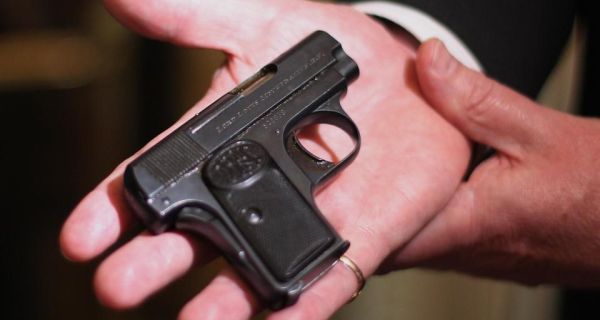
Peter Murtagh had an article in the Irish Times today about a firearm belonging to the late Lord Louis Mountbatten being returned to his family, entitled “Mountbatten handgun returned to family by Defence Forces and Garda”. The firearm is pictured (below) and the original text of the article said that it's a “Barretta” .22 caliber.

A late model FN M1906 chambered for .25 ACP is not a “Barretta .22”


Everything about this description is wrong. First of all, the name of the Italian arms manufacturer in question is “Beretta”, with one “r” and an “a” only at the end. Since the original article was published, they've half-corrected the spelling: it now reads “Berretta”.

Secondly, the firearm pictured was manufactured by the Belgian Fabrique Nationale, better known as “FN”, so it's not a Beretta at all (the first clue is that it has an ordinary ejection port and not the open-top slide that you might expect for an older Beretta). It has the oval “intertwined ‘F’ and ‘N’” logotype of FN, not either of the circular logos used by Beretta (older models have a “PB”, for Pietro Beretta, logotype; more modern ones have a “three arrows” emblem). This can be verified by the simple expedient of turning the damn thing over and reading what it says on the other side:

FABRIQUE NATIONALE D'ARMES de GUERRE HERSTAL BELGIQUE
BROWNING'S PATENT-DEPOSE

 Finally, it's chambered for .25 ACP and not .22 caliber.

The particular weapon pictured is actually the third iteration of FN's Model 1906: you can tell this from the flange on the front of the trigger, which was added in the third version. The first version, released in 1905, had only the Colt 1911-style grip safety that you can see in the photograph; a thumb safety was added (on the other side) in the second version, and enlarged in the third version when the front of the trigger was also widened. This is by far the most common version, accounting for over a million of the 1.2 million or so made. The basic design was licensed from legendary firearm designer John Browning by FN, amongst many other manufacturers. A dozen or more firearm manufacturers produced “Baby Brownings” like this between 1905 and 1940 or so.

In fairness, Beretta produced a number of superficially similar pocket pistols during the same period, but they are markedly different in many respects, having an open-top slide, much different grip safety and trigger guard, and, most importantly, a completely different company logo!

Now, I'm not a gun nut by any means, but the ported (rather than open-top) slide and misspelling of the supposed manufacturer's name made me investigate a little further. It took me all of 15 minutes on the Internet to find out the above. If I can do it, so can a professional journalist.